

2026 Annual Sustainability Report
Use the buttons below to navigate between sections or return to report home.

Sustainable City Operations
City Objective: Improve the environmental performance of City operations by integrating sustainability and resiliency values into City plans, programs and policies.
◀️The new solar canopy at Kapolei Hale keeps cars cool and comfortable for Leeward residents accessing City services, while generating clean energy that avoids 1,200 metric tons of carbon pollution annually—equivalent to taking nearly 300 cars off the road each year!
Credit: Department of Design and Construction
Through the services it provides every day, the City plays a critical role in leading by example—demonstrating how public operations can become more efficient, resilient, and sustainable over time.
In 2025, the City took important steps to turn that vision into action through new investments, projects, and partnerships that increase community resiliency, reduce carbon pollution, and also deliver on long-term savings for taxpayers.
A major milestone last year was the activation of the City’s Climate Resiliency Fund (CRF), which was created by O‘ahu voters in 2024. Following the Honolulu City Council’s adoption of Ordinance 25-23 to guide implementation and administration of the fund, the City approved the inaugural CRF allocation of more than $8 million to advance a diverse pipeline of projects that work to embed sustainability and resiliency into facilities, infrastructure, and community programs.
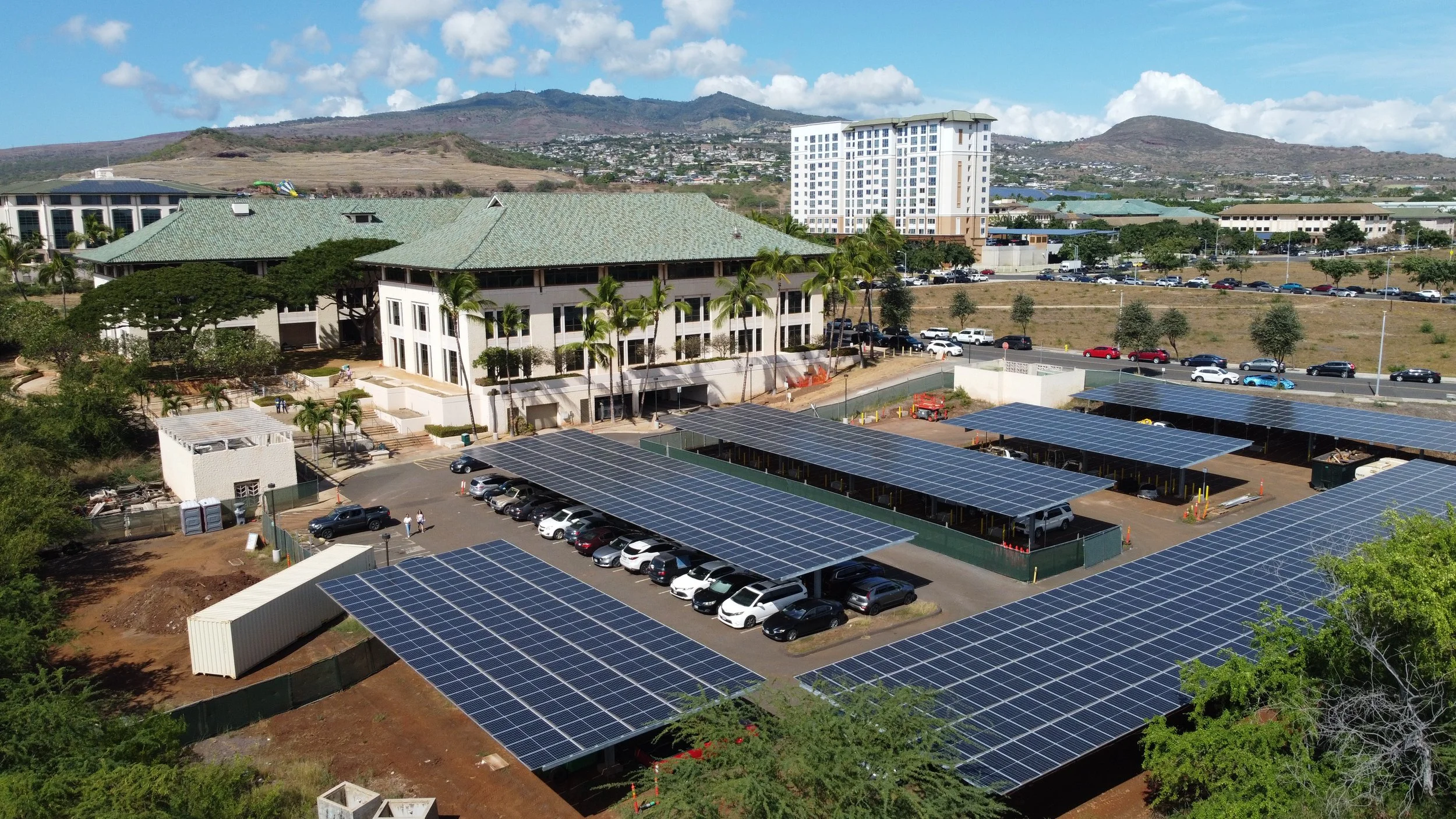
Progress is also visible across City facilities. In 2025, new solar photovoltaic (PV) systems came online at Kapolei Hale, the Neal Blaisdell Center, and the Ala Wai Golf Course, collectively generating nearly 6 million kilowatt-hours of clean electricity each year. These renewable energy systems significantly reduce reliance on fossil fuels, avoid thousands of metric tons of carbon pollution annually, and reduce taxpayer expenses from lower operating costs. From powering nearly 100% of the Blaisdell’s daytime energy needs to offsetting energy use at everyday public facilities, these projects are actively delivering environmental, operational, and financial benefits.
Key Performance Indicators
Municipal Electricity Use
Electricity Consumption by City Department, in Kilowatt Hours (kWh)
Municipal Water Use
Water Consumption by City Department, in Million Gallons per Day (MGD)
Municipal Fuel Use
Fuel Consumption by City Department, in Million Gallons
Municipal Passenger Fleet
City Target: 100% renewable passenger fleet
Number of City Vehicles by Type
For this dataset, “Electric Vehicles” includes battery electric vehicles and plug-in hybrid electric vehicles (PHEV).
Municipal Bus Fleet
Number of City Vehicles by Engine Type
Municipal On-Site Renewable Energy
Renewable Energy Generated from Solar Photovoltaic (PV) on City Facilities, in Kilowatt Hours (kWh)
The increase in the City’s onsite solar PV generation in 2025 was largely driven by three major new PV systems that came online at Kapolei Hale, Ala Wai Golf Course, and the Neal Blaisdell Center, significantly expanding the City’s solar capacity. Altogether, City systems generated over 12 million kWh in 2025, which helps lower energy costs for public facilities and reduces long-term taxpayer expense.
Municipal Buildings Benchmarking
Energy Use Intensity (EUI) of City Facilities, per Square Feet Area (ft²)