

2026 Annual Sustainability Report
Use the buttons below to navigate between sections or return to report home.

Food Systems
City Objective: Foster a just, environmentally sustainable, prosperous, equitable, and resilient community-based food system for O‘ahu.
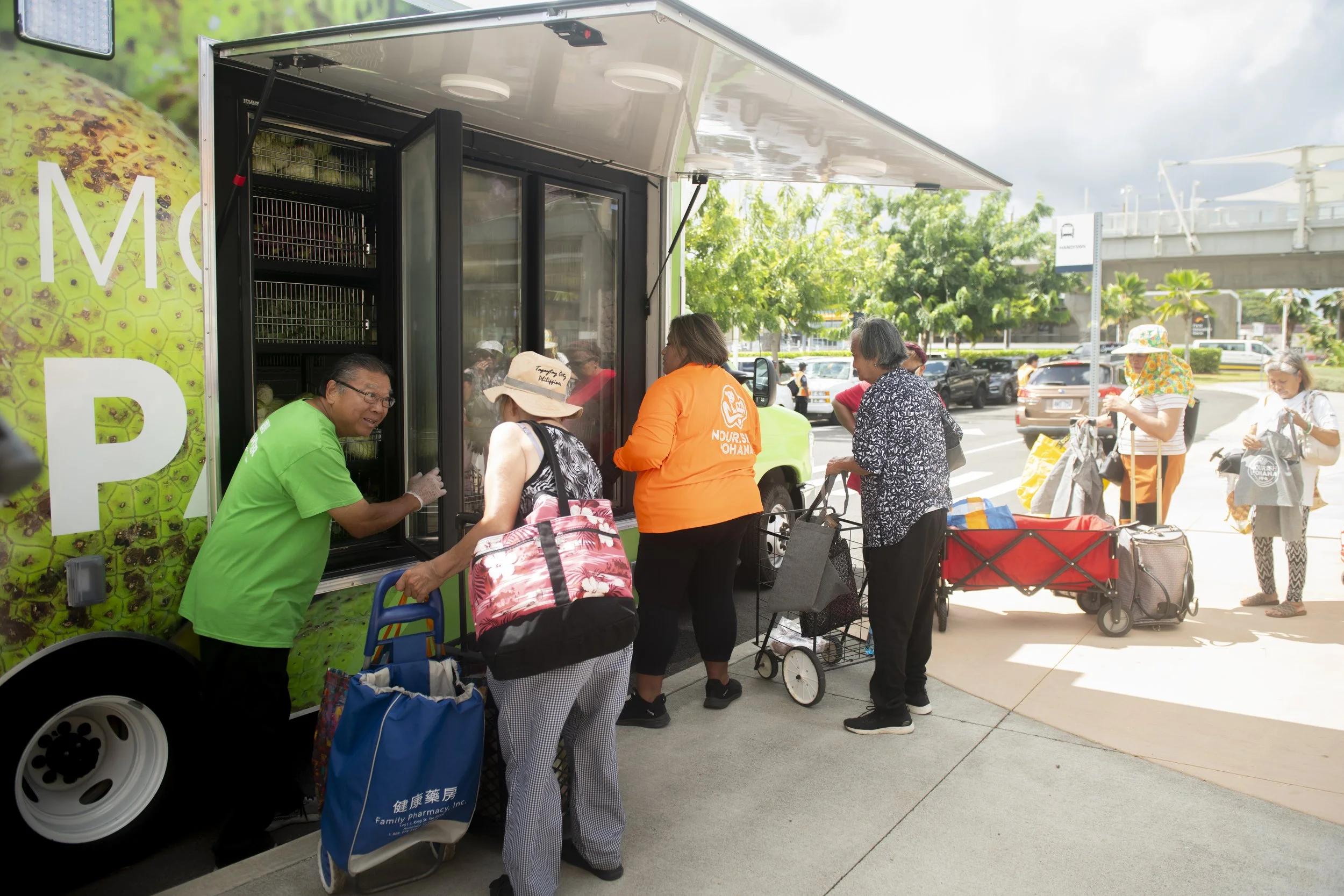
◀️ Stations of Abundance hosted a food distribution event at Skyline’s Hō‘ae‘ae Station with a mobile food pantry and mākeke mahiʻai (farmers market) to bring fresh, healthy, and local food closer to where people live and commute.
Credit: Office of Economic Revitalization
2025 marked a year of rethinking and expanding where Oʻahu grows, shares, and accesses food.
Stations of Abundance emerged as an interagency initiative to transform Skyline stations into community-centered hubs for food access, public health, and resilience. The initiative grew out of Honolulu’s selection as a finalist in the Bloomberg Philanthropies 2025 Mayor’s Challenge, receiving $50,000 to prototype innovative uses of Skyline stations to improve food access. Pilot events at two stations—including farmers markets, mobile food pantry services, and food and cultural planting projects—received overwhelmingly positive community feedback.
Together, these efforts show how public infrastructure can go beyond transit, creating spaces where local farmers share their products, residents access food, and community connections grow.
The City also celebrated a major milestone last year: 50 years of the Recreational Community Gardening Program! Building on this legacy, the City is working to expand access to community gardening. In 2025, the City proposed a new garden at Asing Community Park—identified through community input and site analysis as a strong opportunity to bring green space and gardening to underserved nearby residents. The City also finalized the first comprehensive update to its community garden rules in four decades. The updated rules modernize City processes and ensure these treasured community spaces remain safe, equitable, and sustainable for years to come.
Efforts like these are helping to inform the City’s first-ever Oʻahu Food Systems Plan—a comprehensive, community-driven roadmap that outlines concrete actions the City can take to strengthen the island’s food system over the next five years. Learn more and stay engaged as the draft plan approaches public release in summer 2026: resilientoahu.org/foodsystems.
Key Performance Indicators
Household Food Insecurity
Percent of O‘ahu Households Experiencing Food Insecurity, Over a 12-Month Period
While food insecurity rates for the City and County of Honolulu are lower than the statewide average, 25% of household food insecurity represents approximately 245,000 O‘ahu residents, surpassing the level of need seen during the height of the COVID-19 pandemic (source: Hawaii Foodbank).
Economic Vulnerability & Food Insecurity
Percent of O‘ahu Households Below the Asset Limited, Income Constrained, Employed (ALICE) Threshold, by Zip Code and Rate of Food Insecurity
Cost of living is a key driver of food insecurity, often forcing families to cut back on meals or choose cheaper, less nutritious options to afford other needs like rent, healthcare, and transportation. Understanding these broader financial pressures is key to addressing food security. This map shows the percentage of households on O‘ahu that are classified as Asset Limited, Income Constrained, Employed (ALICE). Although ALICE households earn above the poverty line, they often still cannot afford basic necessities like food.
SNAP Eligibility Gap
Percent of Food Insecure Persons, by Supplemental Nutrition Assistance Program Eligibility
Federal nutrition assistance programs like the Supplemental Nutrition Assistance Program (SNAP) help families afford food. However, more than 5 out of 10 food-insecure Oʻahu residents were not eligible to receive SNAP benefits because they earn more than the eligibility threshold (200% of the Federal Poverty Level) or are denied access for other reasons. Learn more at: Feeding America Map the Meal Gap.
Food Assistance Map
Geographic Locations of Food Assistance Services and Providers, by Assistance Type
To look for food assistance near you, use the zoom controls on the top right corner of the map and navigate to where you are. Hover your pointer on a food assistance location represented by a dot on the map to view the site address, days and hours of operation, contact number, and other information. Find out more about how to get help from the Hawaiʻi Food Bank.
Emergency Food Preparedness
Percent of O‘ahu Households with Recommended 14-Day Store of Food, Water and Medical Supplies
The Hawaiʻi Emergency Management Agency (HIEMA) recommends 14 days' worth of essential supplies—food, water, medicine—as sufficient in preparing for an emergency. According to a 2024 HIEMA report, only 11.5% of Oʻahu households have enough essential supplies stored if an emergency were to happen.